
Designing a commercial restroom isn’t just about fitting in stalls and sinks. The way a bathroom is sized and planned directly affects comfort, accessibility, traffic flow, cleanliness, and even the building’s long-term maintenance demands.
When the layout is done right, people move through the space easily, privacy feels natural, and upkeep stays manageable. When it’s wrong… well, you get overcrowded hallways, long waits, frustrated users, and costly redesigns down the line.
This blog breaks down the fundamental considerations behind commercial bathroom size requirements, from minimum dimensions and ADA accessibility needs to layout strategy and code expectations. It’s built for architects, contractors, property managers, and facility teams who want clarity instead of guesswork.
We’ll discuss the process, the logic behind it, and how thoughtful restroom planning creates spaces that feel functional, safe, and modern.
Also, if you’re working on a new build or renovation, we’ll also share how GS Parcel supports properties with expert installation of restroom partitions and system components that meet code and withstand real daily traffic.
Why Commercial Bathroom Size Requirements Matter in Real Projects
Commercial restroom design standards are anchored in safety, hygiene, and fair access. But they are also tied to business outcomes.
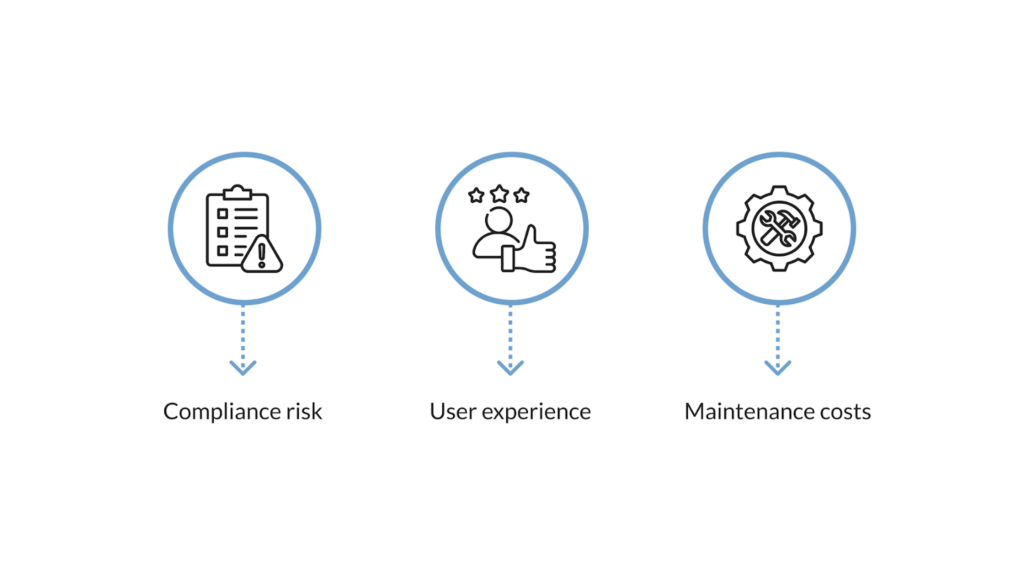
- Compliance risk: Failing to meet Building code bathroom requirements or commercial bathroom accessibility rules can delay occupancy permits and trigger costly redesigns.
- User experience: Tight layouts cause crowding, poor privacy, and discomfort, especially in high turnover facilities.
- Maintenance costs: Restrooms that fail to meet Restroom clearance requirements or commercial restroom fixture spacing requirements are harder to clean and wear out faster.
Because of these realities, commercial bathroom size requirements should be set early, not after floor plans are locked.
How to Plan and Implement Commercial Bathroom Size Requirements the Right Way
Before drawings are finalized and fixtures are ordered, sizing decisions must be made. Use this framework to design a commercial restroom that’s compliant, efficient, and built for everyday use.
Step 1: Start With Occupancy & Commercial Building Restroom Codes
Every layout begins with the expected occupant load. Commercial building restroom codes and Public restroom regulations determine the minimum number of fixtures and, therefore, the baseline footprint.
Calculate Fixture Counts First
- Use the local Building code bathroom requirements for your building type and occupancy class.
- Confirm whether the jurisdiction requires separate male and female rooms or allows all gender options.
- Plan for growth. A restroom sized to the current headcount can fail in two years.
These counts drive your minimum commercial restroom size, because each fixture zone requires clear space for use and service.
Translate Fixture Counts Into Minimum Commercial Restroom Size
As a planning benchmark, allow area for:
- Stall zones
- Urinals where applicable
- Lavatory and drying zones
- Circulation and queuing
Public restroom space planning often needs more circulation space than office restrooms because of surges. Office bathroom layout guidelines typically assume steadier traffic and shorter queues.
GS Parcel supports projects at this stage by helping teams estimate fixture-driven footprints and align layouts with commercial bathroom size requirements before detailed drawings begin.
Step 2: Core Commercial Bathroom Size Requirements & Layout Zones
Once fixture counts are known, apply commercial bathroom size requirements to the key zones.
Entry & Circulation
- Doors must not collide with sinks or stall doors.
- Provide clear aisles for two-way flow when occupancy is high.
- Keep approach paths wide enough to meet Restroom clearance requirements.
Stall Bank Depth & Aisle Width
- Standard stalls set the depth of the stall bank.
- The aisle in front must allow door swing and safe passing.
- This is where commercial bathroom layout standards often fail, by over-sizing stalls and under-sizing circulation.
Lavatory Zone Length
Commercial lavatory size requirements cover:
- Sink width per user
- Knee and toe clearance for accessible sinks
- Reach ranges for soap, towel, and dryer accessories
Lavatory spacing is a major contributor to overall commercial bathroom size requirements and to user comfort.
Step 3: Accessibility Focus with ADA Commercial Restroom Requirements
ADA commercial restroom requirements must be integrated into the footprint, not added later. This is both a legal and functional need.
ADA Bathroom Dimensions & Turning Space
ADA bathroom dimensions require a wheelchair turning area, usually a 60-inch turning circle or T-turn equivalent. This turning space must be free of obstructions and positioned so that access does not force a user into traffic.
If you plan ADA bathroom dimensions from the beginning, you avoid dead corners and wasted square footage.
ADA Toilet Stall Dimensions & Accessible Toilet Stall Requirements
ADA toilet stall dimensions specify minimum widths, depths, door clearances, and the placement zones for grab bars. These Accessible toilet stall requirements also guide the location of stall door swing and latch hardware.
Commercial restroom ADA guidelines typically require:
- At least one accessible stall per restroom
- Clear turning and approach space inside or adjacent to that stall
- Correct fixture height and grab bar alignment
These accessible toilet stall requirements expand the Minimum commercial restroom size slightly, but they are non-negotiable.
Commercial Bathroom Accessibility Rules Beyond Stalls
Commercial bathroom accessibility rules also apply to:
- Accessible lavatory heights and clearance
- Mirror and accessory reach ranges
- Door hardware and opening force
- Path of travel from entry to each zone
Commercial restroom ADA guidelines require the accessible route to remain clear even during peak traffic. GS Parcel helps verify these routes and stall placements during layout review.
Step 4: Commercial Restroom Fixture Spacing & Clearance Logic
Good layouts are not only about fitting fixtures. They are about spacing them so the room works.
Commercial Restroom Fixture Spacing
Commercial restroom fixture spacing covers:
- Centerline distances between toilets or urinals
- Sink to sink spacing
- Stall to sink separation to reduce bottlenecks
Proper spacing of commercial restroom fixtures supports sanitation and reduces collisions between users.
Restroom clearance requirements
Restroom clearance requirements include:
- Door swing clearance
- Fixture approach clearance
- Circulation aisle clearance
- Maintenance access clearance
Commercial Toilet Partition Spacing
Commercial toilet partition spacing refers to the precise distances needed between partitions, walls, doors, and hardware. If partitions are too tight, stalls feel cramped, and cleaning access suffers.
GS Parcel designs partition systems that align with commercial toilet partition spacing standards, ensuring both code compliance and practical use.
Step 5: Privacy & Comfort within Commercial Bathroom Size Requirements
People choose facilities that feel safe and comfortable. Privacy depends more on layout than on decor.
Strategies That Improve Privacy Without Expanding Footprint
- Use sightline blocks between the entry and stall doors.
- Angle stall approaches are used where possible.
- Position urinals out of direct line of sight.
These tactics fit within commercial bathroom size requirements while boosting perceived quality.
Comfort-based Spacing
Office bathroom layout guidelines often focus on quick use and speed. Public restroom space planning prioritizes comfort during higher dwell times. Align your plan to your real audience.
Step 6: Commercial Bathroom Code Compliance Checklist
Here is a working checklist for commercial bathroom code compliance.
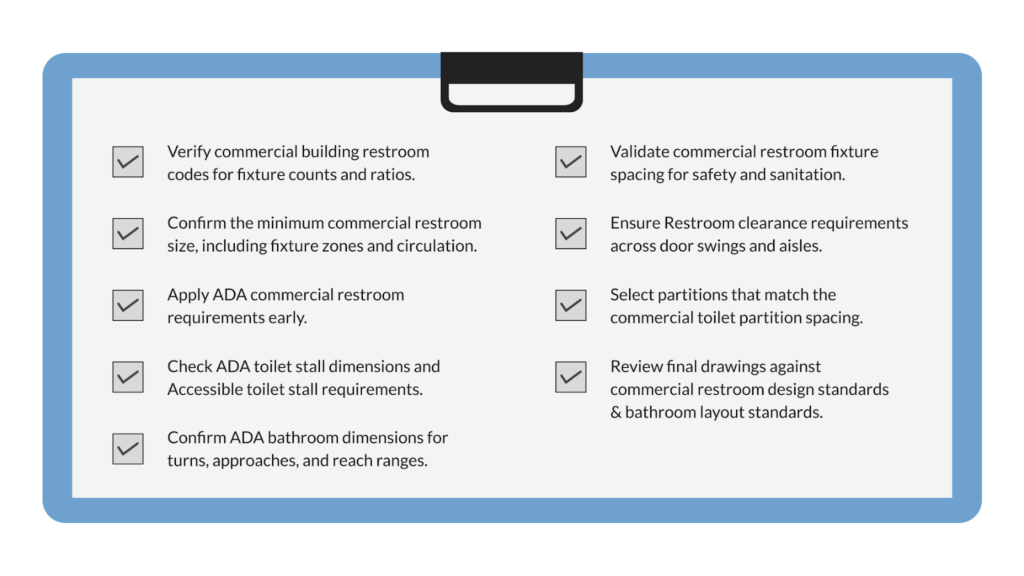
A final review against commercial bathroom code compliance reduces inspection risk and change orders.
Step 7: Recommended Commercial Bathroom Size Requirements by Facility Type
Offices
Office bathroom layout guidelines usually require:
- Predictable fixture use during breaks
- Clear circulation for quick turnover
- Durable partitions for daily cleaning
Keep the accessible stall close to the entry for easy routing, and confirm the commercial lavatory size requirements for accessible sinks.
Retail & Hospitality
Public restroom regulations are strict here due to variable traffic and family needs. Public restroom space planning should include:
- Wider circulation aisles
- Extra turning zones
- More spacious queue space near the entry
Education & Recreation
Commercial restroom design standards for these facilities focus on durability and vandal resistance. Phenolic or HDPE partitions are standard because they meet commercial toilet partition spacing requirements and withstand heavy use.
Healthcare & Transportation
These spaces must prioritize commercial bathroom accessibility rules and strict sanitation. Provide clear turning zones and wide, unobstructed routes in line with commercial restroom ADA guidelines.
GS Parcel helps select partition materials and configurations for each facility type without breaking commercial bathroom size requirements.
Step 8: Common Mistakes That Break Commercial Bathroom Size Requirements
- Designing stalls first and circulation last
- Treating ADA commercial restroom requirements as an add-on
- Underestimating sink queues and ignoring commercial lavatory size requirements
- Missing local variations in Public restroom regulations
- Installing partitions without rechecking the commercial toilet partition spacing
- Using a single generic plan for every building type, instead of following commercial building restroom codes and Office bathroom layout guidelines
Avoiding these mistakes protects your budget and keeps your restroom operational from day one.
How GS Parcel Supports Compliant Restroom Design & Build
GS Parcel works alongside design and construction teams to reduce rework and inspection risk by validating sizing, clearances, and ADA logic early. We help ensure your restroom plan is code-ready on paper before it becomes costly in the field.
What This Support Looks Like
- Code & sizing review before final drawings: We check fixture counts, stall layouts, and circulation against local restroom codes so your footprint aligns with required sizing from day one.
- Clearance & usability checks: We flag real-world pinch points that designers often miss, such as door swings colliding with lavatory zones or insufficient cleaning access behind partitions.
- Accessibility mapped into the layout: We verify accessible stall placement, turning zones, and reach ranges so ADA compliance works in practice, not just on a schematic.
- Partition layout engineering: We translate stall counts into accurate partition runs, hardware placement, and spacing requirements so installs don’t require field improvisation.
- Spec guidance tied to environment: We recommend partition types and finishes based on traffic load, humidity exposure, vandal risk, and expected maintenance cycles.
If you’re in planning mode, this is where GS Parcel saves the most time and cost, by catching layout problems before construction starts.
Transform Your Restrooms with Code-Ready Space Planning from GS Parcel
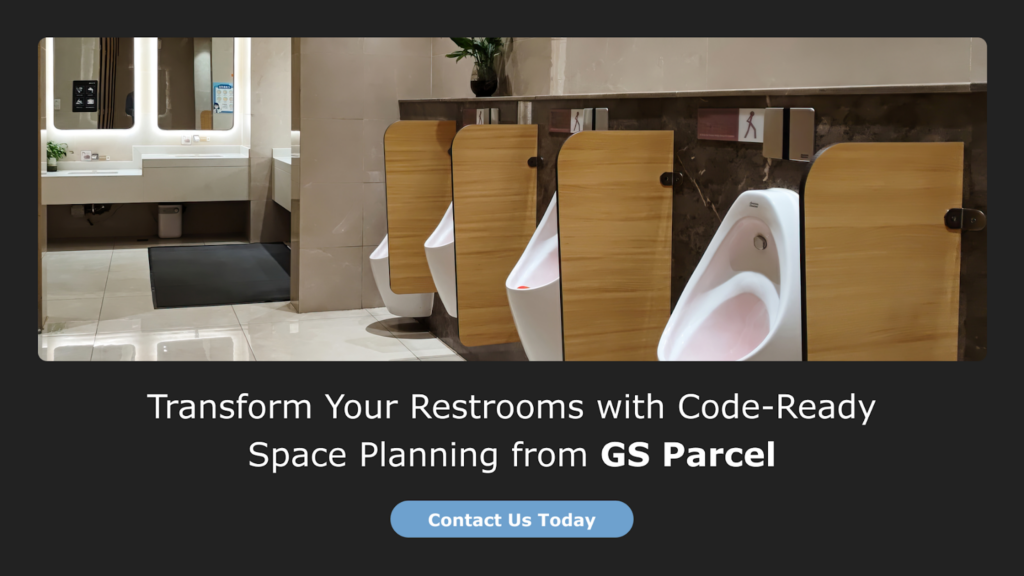
GS Parcel provides durable toilet partitions, urinal screens, and restroom accessories that fit your approved layout and elevate privacy, hygiene, and long-term performance. Whether you are upgrading a single office restroom or outfitting a high-traffic public facility, we install systems built to handle daily demand while remaining fully compliant.
Here’s what you get with GS Parcel:
- Commercial partitions for every build type: Floor-mounted, overhead-braced, ceiling-hung, floor-to-ceiling, and full-privacy partition systems tailored to your footprint.
- Urinal screens for cleaner sightlines: Added privacy and better flow in multi-fixture restrooms without expanding square footage.
- Material options chosen for durability: Powder-coated steel for value, stainless steel for premium spaces, and HDPE for moisture-heavy or high-impact environments.
- Complete accessory fit-out: Touchless sinks, soap and towel dispensers, hand dryers, grab bars, mirrors, baby-changing stations, and hygiene accessories, selected to meet ADA requirements and facility use.
- Professional installation and support: Site measurements, installation, warranty coverage, and maintenance support to keep the restroom reliable long after handover.
Ready to plan a compliant, modern restroom? Call us at (866) 233-3597 to review your layout and get a solution tailored to your space.
