
Elevator shafts pose one of the biggest smoke-movement risks in high-rise buildings. During a fire, smoke can travel rapidly through these vertical openings and spread to multiple floors within minutes. Controlling that movement is critical because smoke often reaches occupants long before flames do.
Research on fire toxicity and smoke movement has shown that more than 75% of fire fatalities are linked to smoke inhalation and fire toxicity rather than direct burns.
An elevator smoke curtain is an important part of modern fire and smoke containment strategies. These systems deploy automatically around elevator openings during an emergency to help slow smoke migration and protect surrounding spaces. Although the curtain itself appears simple, the engineering behind it involves advanced materials, gravity-fail mechanics, electronic controls, and highly precise installation requirements.
Why Elevator Openings Create a Major Smoke Containment Challenge
Elevator shafts behave like vertical chimneys during a fire. As heat rises, smoke is pulled upward through the shaft and can spread rapidly to multiple floors. This movement, often referred to as the stack effect, creates one of the biggest challenges in high-rise fire safety design.
Without proper containment, smoke can travel far beyond the original fire floor within minutes. Elevator lobbies, corridors, and adjacent spaces become vulnerable even when flames remain confined to a single area.
Uncontrolled smoke migration creates several serious risks:
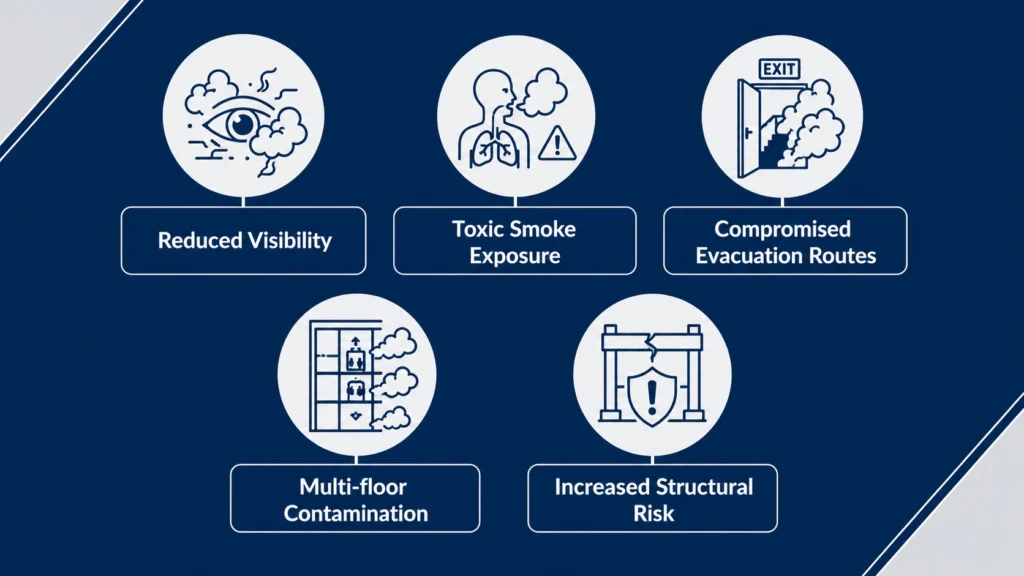
- Reduced visibility: Smoke quickly limits visibility in evacuation routes and common areas
- Toxic smoke exposure: Occupants on non-fire floors can still become exposed to dangerous smoke conditions
- Compromised evacuation routes: Stairwells and elevator lobbies may become unsafe during evacuation
- Multi-floor contamination: Smoke spreads far beyond the original fire location through connected vertical spaces
- Increased structural risk: Heat and smoke movement can affect multiple building systems simultaneously
This is why elevator hoistway smoke protection has become such an important part of modern fire and smoke containment strategies. Controlling smoke movement around elevator openings helps slow vertical smoke migration and preserve safer conditions throughout the building.
What Is an Elevator Smoke Curtain?
| An elevator smoke curtain is a deployable smoke containment system that seals off elevator openings during a fire event. The curtain remains hidden inside a compact headbox above the elevator until smoke detectors or the building’s fire alarm system trigger deployment. |
Once activated, the curtain descends automatically around the elevator opening to create a smoke barrier that helps reduce smoke migration through the shaft.
Unlike conventional fire doors or shutters, an elevator smoke curtain is created specifically for smoke and draft control. The system focuses on limiting air leakage and smoke movement rather than serving as a heavy structural barrier.
These systems are commonly used in:
- High-rise office buildings
- Hotels
- Healthcare facilities
- Mixed-use developments
- Educational campuses
- Commercial towers with open lobby designs
One reason these systems have become increasingly popular is their minimal visual impact. During normal operation, the curtain remains completely concealed, allowing architects to maintain clean ceiling lines and open lobby aesthetics without bulky visible barriers.
Many elevator smoke curtain systems are also tested to UL 1784 smoke ratings, which evaluate smoke and draft control performance under controlled-leakage conditions. This standard helps measure how effectively the system limits smoke passage around openings during a fire event.
Although the curtain itself may appear straightforward, its performance depends heavily on the engineering behind the materials, deployment mechanics, and sealing systems.
High-Performance Materials for Elevator Smoke Containment
The performance of an elevator smoke curtain begins with the fabric itself. Standard textile materials cannot survive the heat exposure, smoke pressure, and environmental demands associated with fire events. Specialized technical fabrics are therefore required to maintain containment performance under extreme conditions.
Many systems use materials such as:
- Polyurethane-coated fiberglass fabrics
- Silica-based textiles
- Reinforced woven technical fabrics
These materials are engineered specifically for smoke containment applications.
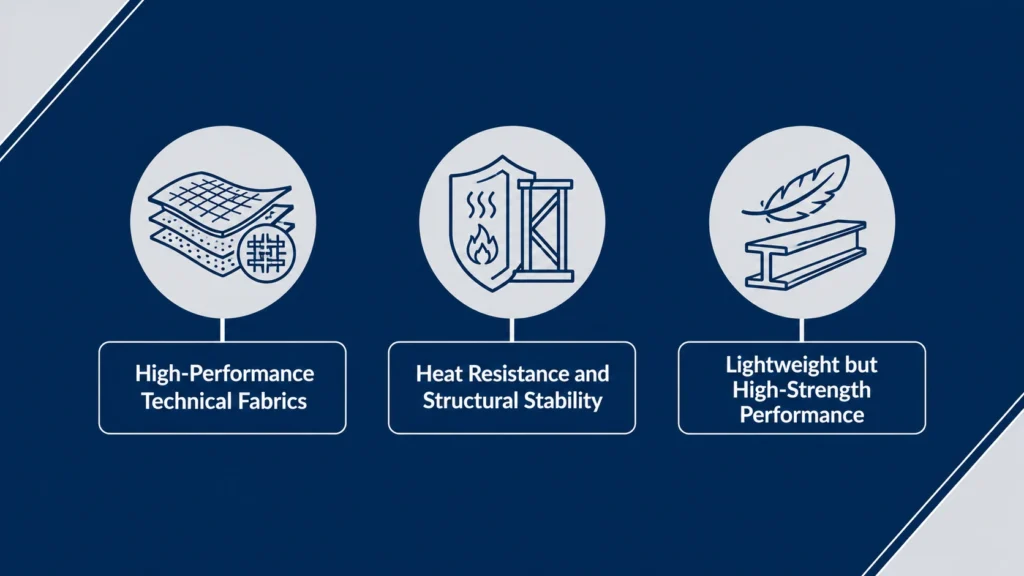
High-Performance Technical Fabrics
Fiberglass-based fabrics are commonly used because they provide strong dimensional stability while remaining lightweight enough for controlled deployment. Specialized coatings improve smoke resistance and help reduce air leakage through the material surface.
Silica-based fabrics are often selected for applications requiring extremely high heat resistance. These textiles can withstand elevated temperatures without melting or rapidly degrading.
Unlike conventional fabrics, these engineered materials:
- Resist heat damage
- Maintain structural integrity
- Reduce smoke penetration
- Avoid excessive shrinkage
- Operate repeatedly without tearing or deformation
Heat Resistance and Structural Stability
Heat exposure creates major challenges for smoke containment systems. Materials must remain stable at elevated temperatures while maintaining proper sealing performance.
If a curtain warps, shrinks excessively, or loses dimensional stability, smoke can escape through gaps around the opening.
Modern smoke curtain fabrics are engineered to maintain consistent performance under fire conditions while limiting off-gassing and material breakdown.
Lightweight but High-Strength Performance
Although these fabrics are extremely durable, they must also remain lightweight enough to support controlled deployment. Excessively heavy materials can place stress on motors, tracks, and release systems.
The balance between flexibility, weight, strength, and thermal resistance is one of the most impressive aspects of smoke barrier engineering.
The fabric alone, however, is only one part of the system. Reliable deployment mechanics are equally important.
Gravity-Fail Deployment Engineering
An elevator smoke curtain must deploy reliably during emergency conditions, including complete building power failure. This is why many systems rely on gravity-fail deployment engineering.
Instead of depending entirely on powered motor operation during an emergency, the system uses controlled gravity-assisted descent to ensure deployment occurs even if electrical systems fail.
Weighted Bottom Bar System
Most elevator smoke curtain systems include a weighted bottom bar that stabilizes the curtain during deployment.
This component serves several functions:
- Helps guide controlled downward movement
- Maintains curtain tension during deployment
- Improves edge sealing consistency
- Reduces curtain flutter caused by airflow conditions
The weighted bar also helps maintain dimensional alignment as the curtain descends into position.
Importance of Gravity Fail-Safe Design
Power loss is common during fire emergencies. Smoke containment systems, therefore, cannot rely solely on active motor power to function properly.
Gravity-fail deployment ensures the curtain can still descend even during:
- Electrical failure
- Alarm-triggered shutdown conditions
- Emergency power interruptions
- Mechanical system failures
This fail-safe approach improves reliability under the exact conditions where smoke containment becomes most critical.
Controlled Descent Technology
Although deployment relies on gravity, the curtain cannot simply drop uncontrolled into place. Modern systems use controlled-descent mechanisms to regulate deployment speed.
This helps:
- Protect occupants near the opening
- Reduce stress on the fabric and tracks
- Maintain smoother sealing alignment
- Improve overall operational reliability
The mechanical simplicity of gravity-assisted deployment is one reason elevator smoke curtains are considered highly dependable life-safety systems.
Deployment, however, still depends on intelligent coordination with building fire systems.
Electronic Releasing Devices and Alarm Integration
Even though the curtain deploys mechanically through gravity-fail operation, activation begins electronically.
Elevator smoke curtains are integrated directly with the building’s fire alarm and smoke detection systems. Once smoke detectors or alarm panels detect an emergency, electronic release devices automatically trigger curtain deployment.
These systems coordinate with:
- Building fire alarm panels
- Smoke detection systems
- Emergency communication systems
- Smoke management controls
- Elevator recall sequences
This integration allows automatic smoke curtains to respond quickly without requiring manual activation.
Electronic releasing devices are carefully engineered to maintain reliability while reducing the likelihood of accidental deployment. Systems must balance responsiveness with operational stability because false activations can disrupt building operations.
Modern control systems also support testing, diagnostics, and coordinated emergency-response protocols to help facility teams monitor performance over time.
Once deployment begins, however, the curtain’s effectiveness depends heavily on perimeter sealing performance.
Engineering the Seal and Track System
The curtain fabric itself cannot fully control smoke movement without an effective sealing system. Smoke naturally seeks pathways through gaps, edges, and pressure differentials. This makes track engineering one of the most critical aspects of elevator smoke curtain performance.
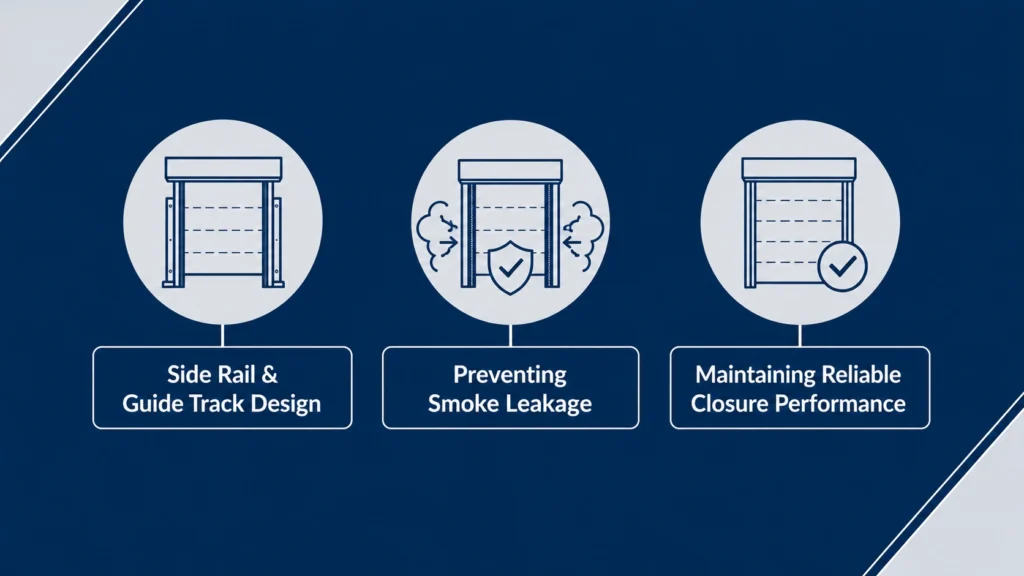
Side Rail & Guide Track Design
Guide tracks help direct the curtain during deployment while maintaining alignment throughout the full descent path.
These side rails are engineered to:
- Maintain edge positioning
- Reduce lateral movement
- Improve sealing consistency
- Support repeatable deployment cycles
Even small alignment variations can create leakage points that reduce the effectiveness of smoke containment.
Preventing Smoke Leakage
Smoke leakage control is one of the primary performance goals of these systems. Poorly engineered tracks or loose tolerances can allow smoke to escape around the perimeter even if the fabric itself remains intact.
Many systems are tested to UL 1784 air-leakage standards, which evaluate smoke and draft-control performance under specific pressure conditions.
These standards help assess:
- Leakage rates
- Perimeter sealing effectiveness
- Draft control performance
- Smoke barrier integrity
Precision becomes especially important because high-rise buildings often experience changing pressure conditions during fire events.
Maintaining Reliable Closure Performance
Repeated operation places ongoing stress on certain systems. Tracks, rollers, and guide systems must therefore resist wear and maintain alignment over time.
Reliable performance depends on:
- Tight dimensional tolerances
- Smooth deployment cycles
- Stable track geometry
- Resistance to deformation
This engineering precision also allows elevator smoke curtains to remain visually discreet within modern architectural environments.
Space-Saving Engineering and Architectural Integration
Traditional fire barriers often create visual and spatial challenges within modern buildings. Large fire doors, shutters, or fixed barriers can interrupt open lobby layouts and reduce design flexibility.
Elevator smoke curtains solve this problem through compact concealed integration.
Most systems remain hidden inside relatively small ceiling headboxes until deployment occurs. This allows architects to preserve clean ceiling lines and uninterrupted visual openness throughout the lobby.
| Elevator Smoke Curtains | Traditional Fire Doors/Shutters |
| Concealed during normal operation | Permanently visible |
| Compact headbox footprint | Larger physical footprint |
| Minimal architectural disruption | More visual obstruction |
| Automatic deployment | Fixed barrier presence |
| Better support for open designs | Reduced layout flexibility |
This space-saving design makes elevator smoke curtains especially valuable in:
- High-rise developments
- Luxury commercial buildings
- Hotels
- Mixed-use towers
- Open atrium environments
The ability to combine life safety performance with architectural flexibility is one of the biggest reasons these systems continue to gain popularity in modern construction.
Achieving reliable performance, however, depends heavily on installation precision.
Why Precision Installation Is Required for Elevator Smoke Curtains
Even highly engineered systems can underperform if installation tolerances are incorrect. Elevator smoke curtains operate within relatively narrow dimensional margins, especially around elevator openings, where smoke leakage control depends on accurate alignment.
Several installation variables directly affect performance:
- Track alignment
- Ceiling coordination
- Side rail positioning
- Clearance management
- Opening geometry consistency
Common installation challenges include:
- Uneven elevator openings
- Misaligned tracks
- Conflicts with ceiling finishes
- Integration issues with adjacent systems
- Inconsistent mounting tolerances
Because smoke containment depends heavily on perimeter sealing, even small installation inconsistencies can reduce overall performance.
Coordination between architects, fire consultants, elevator teams, and installers is therefore extremely important during specification and construction.
How Granite State Specialties Supports Specialized Elevator Smoke Curtain Installations
GSS supports complex fire and smoke containment projects with specialized experience in elevator smoke curtain systems and related containment assemblies.
This includes support for:
- Elevator lobby smoke protection
- Fire and smoke containment coordination
- Precision track installation
- Concealed ceiling integration
- High-rise safety applications
GSS safety engineering focuses on the detailed coordination required for these systems to perform reliably within demanding commercial environments.
Because elevator openings often involve limited tolerances and multiple adjacent systems, installation requires careful planning and field coordination. GSS works alongside architects, consultants, and contractors to help align containment systems with both performance requirements and architectural goals.
Transform Your Next Project with Advanced Elevator Smoke Curtains from GSS
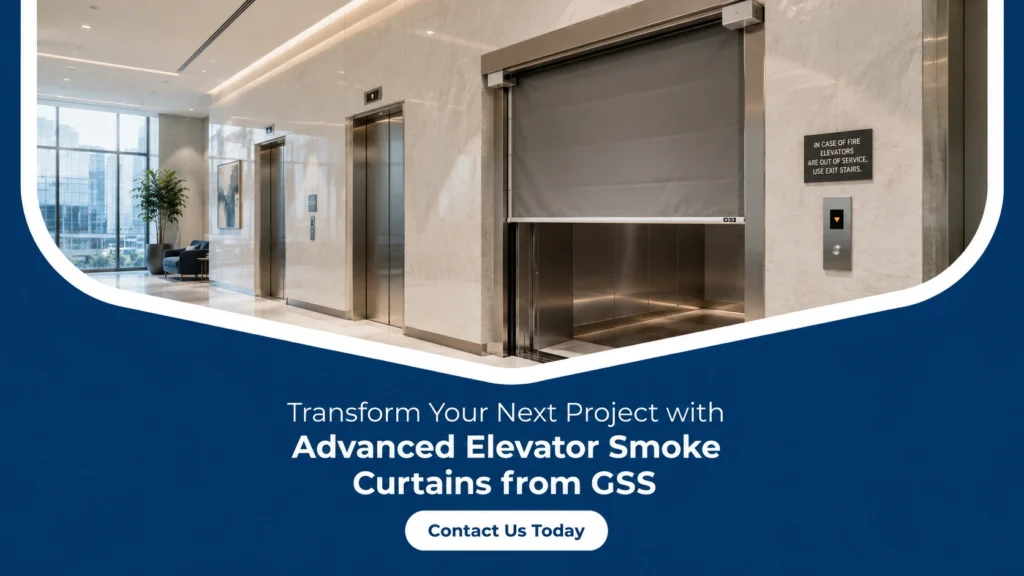
Modern elevator smoke curtain systems combine advanced materials science, gravity-fail mechanics, electronic controls, and precision smoke-barrier engineering into a highly specialized life-safety solution.
These systems help support:
- Concealed smoke protection
- Automatic emergency deployment
- Reduced smoke migration
- Space-efficient architectural integration
- High-rise fire safety compliance
As modern buildings continue to prioritize open layouts and larger vertical spaces, coordinated smoke containment strategies become increasingly important. Properly engineered elevator smoke curtain systems help preserve safer evacuation conditions while supporting the architectural flexibility modern projects demand.Incorporate world-class safety into your next high-rise project. Contact the GSS engineering team for detailed specifications for elevator smoke curtains and installation support.
